
In most industrial and commercial environments, air carries more than dust. Oil aerosols, grease particles, and fine mist are common in manufacturing facilities, automotive spray booths, and food processing plants. When these reach a filter, they do not behave like solid particles they spread, saturate the fiber structure, and progressively choke airflow. A filter that begins at acceptable pressure drop can degrade quickly once oil loading begins.
To protect against this, filter manufacturers apply oleophobic coatings surface treatments that give filter media oil-repelling properties, slowing saturation and extending service life. For decades, the chemistry of choice has been PFAS.
Why the Industry Relied on PFAS
Perfluoroalkyl and polyfluoroalkyl substances offered a genuinely compelling package. Their exceptionally low surface energy prevents oil from spreading across fiber surfaces. They are compatible with existing finishing processes, straightforward to apply at scale, and perform consistently across a wide range of filter formats and operating conditions. For filter media producers, PFAS was not a shortcut it was a technically sound answer to a hard problem.
That is now changing. Regulatory pressure from the U.S. EPA, the European Chemicals Agency, and agencies worldwide is accelerating the phase-out of PFAS across industrial applications, including filtration. The industry needs alternatives and it needs them to actually work.
What Current PFAS-Free Alternatives Offer and Where They Fall Short
Several PFAS-free chemistries are already in use or under active development:
- Silicone-based repellents offer reasonable hydrophobicity but struggle to achieve the surface energy levels that oil repellency in filtration environments demands.
- Fluorine-free polymer coatings have improved meaningfully in recent years, with some formulations approaching acceptable oleophobic performance under controlled conditions.
- Wax-based and bio-derived treatments offer sustainability credentials but tend to lack the durability and thermal stability that industrial filter applications require.
Each of these alternatives faces a shared limitation that goes beyond chemistry. The problem is not only what is being coated it is how the coating is applied.
High-performance filter media is a carefully engineered three-dimensional fiber network with a controlled pore architecture. That pore structure is not incidental it is the product. It determines airflow resistance, particle capture efficiency, dust holding capacity, and filter lifetime. Conventional coating methods dip coating, pad finishing, and roll application deposit material in bulk. The coating solution flows into the spaces between fibers before it sets, bridging pore openings, adding weight across the web, and collapsing the fine fiber intersections that define the media's filtration character.
The result is a trade-off that no chemistry change alone can resolve: increasing coating add-on to improve oleophobicity reliably increases pressure drop. Engineers find themselves caught between two performance requirements that bulk coating methods force into direct conflict:
- More coating → better oil repellency → higher pressure drop → worse energy efficiency
- Less coating → acceptable pressure drop → inadequate oil repellency → shorter filter life
A PFAS-free coating that blocks pores is not a solution — it is a different version of the same problem.
A Different Approach to Deposition
Electrospraying offers a way out of this trade-off. It is an electrostatic deposition process in which a liquid polymer solution is drawn through a high-voltage electric field, producing a fine charged aerosol of droplets. Unlike conventional spray finishing, electrospraying generates extremely small, uniformly sized droplets that are electrostatically driven toward the substrate. The result is a highly controlled thin-film deposition at the micro- and nanoscale.
The precision of this deposition changes what is possible for filter media:
- Droplets are small enough to coat individual fiber surfaces rather than bridge across adjacent fibers
- Each fiber receives a conformal surface treatment while pore openings between fibers remain structurally intact
- The functional coating lives on the fiber not in the spaces between fibers where airflow occurs
Oleophobicity is a surface property it needs to be at the fiber surface where oil contacts the media. Pressure drop is a structural property it depends on how open the pore network remains. Electrospraying addresses both simultaneously, delivering surface-level coverage without flooding the pore geometry that airflow depends on. It is also compatible with a range of PFAS-free oleophobic chemistries, meaning the deposition advantage can be paired with regulation-ready materials rather than waiting for chemistry alone to close the performance gap.
Where This Is Heading
Scaling electrospraying to roll-to-roll production is an active engineering challenge, requiring careful co-development across several variables nozzle configuration, web speed, solution viscosity, and process controls. But the industry direction is clear. Several forces are converging to compress the transition timeline:
- Tightening PFAS regulation across the U.S. and Europe
- Growing customer demand for transparent material disclosure
- Increasing pressure to reduce filter energy consumption
- Performance expectations from ePM1 and MERV 13–14 filtration standards
Filter manufacturers who rely on PFAS coatings today are already fielding requests for PFAS-free alternatives. The question is no longer whether to transition it is how to do so without sacrificing the filtration performance that end users depend on. The organizations that develop validated PFAS-free formulations alongside scalable, fiber-precise deposition processes will define what the next generation of oil-resistant filter media looks like.
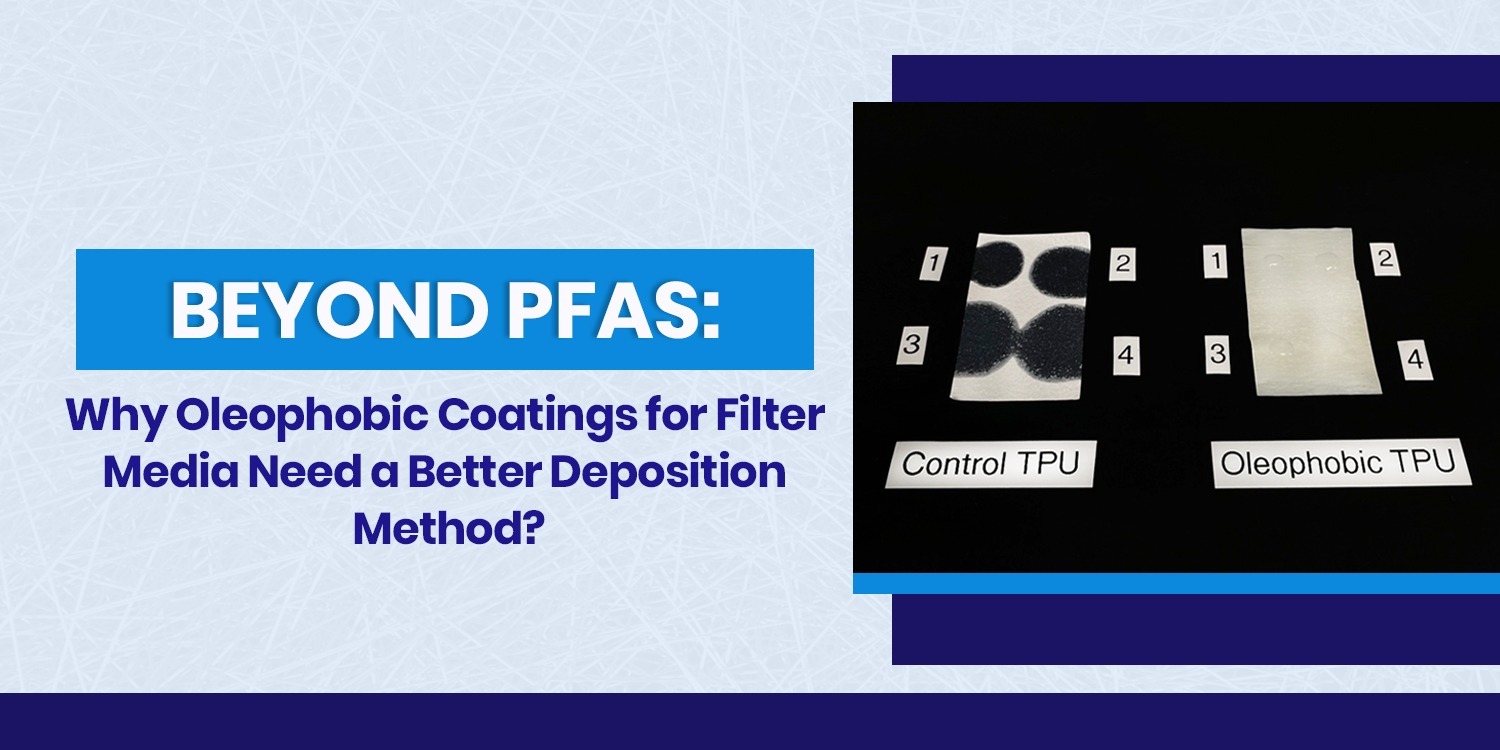
At Matregenix, this is precisely the problem we have been working on. Our electrospraying process deposits PFAS-free oleophobic coatings directly onto filter media fiber surfaces (see image) achieving the oil repellency that industrial applications require while preserving the open pore structure that filtration performance depends on. The image below shows what this looks like at the fiber level: coating distributed across individual fiber surfaces, with pore geometry intact and unobstructed.
If you are exploring PFAS-free filtration solutions or want to understand where this technology is heading, we would love to connect and share what we are learning.