
PFAS-free Oleophobic Nanofiber Venting Membranes vs ePTFE (Specs, Teat data, Sample request)
Sealed enclosures need to breathe. Temperature swings, altitude changes, and outgassing create pressure differences that stress seals, fog optics, distort housings, and push water past gaskets. A venting membrane solves this by letting air and water vapor pass while blocking liquid water, oils, dust, and other contaminants.
For decades, expanded PTFE (ePTFE) has been the default material for this job. PTFE is a fluoropolymer, and oleophobic grades of ePTFE often rely on fluorinated surface treatments. As US federal and state rules on per- and polyfluoroalkyl substances (PFAS) evolve, many OEMs are asking a practical question: is there a PFAS-free membrane that can meet the same performance targets?
PFAS-free oleophobic nanofiber venting membranes are one option engineers are now evaluating. This guide from Matregenix compares them with ePTFE on the specifications that matter, explains which tests to request, and shows how to run a fair sample evaluation. The goal is not to declare a universal winner. It is to help you choose based on verified data for your application.
What Are PFAS-Free Oleophobic Nanofiber Venting Membranes?
A PFAS-free oleophobic nanofiber venting membrane is a porous sheet made of very fine polymer fibers, engineered to repel both water and oils, and formulated without intentionally added PFAS. All three properties must be designed in and verified. Being a nanofiber membrane does not make a product PFAS-free, and it does not make it oleophobic.
How Nanofiber Membrane Technology Works
Nanofiber membranes are commonly produced by electrospinning, which draws a polymer solution into continuous fibers with diameters typically in the submicron range. The fibers lay down as a nonwoven web with high porosity and small, interconnected pores.
That structure gives engineers several levers:
- Fiber diameter influences pore size and particle capture.
- Porosity and thickness influence airflow and pressure drop.
- Polymer chemistry influences temperature, chemical, and mechanical performance.
- Surface treatment influences water and oil repellency.
- Support layer and lamination influence handling, strength, and mounting.
Hydrophobic vs. Oleophobic Performance
Hydrophobic means the surface resists wetting by water. Oleophobic means it also resists wetting by low-surface-tension liquids such as oils, fuels, lubricants, and many surfactant solutions.
The distinction matters because oils have much lower surface tension than water. A membrane can easily shed rain yet wick in motor oil or a cleaning solution. Once a membrane wets out, it can lose airflow and let liquid through. Historically, fluorinated chemistry has been the most common route to strong oleophobicity, which is why achieving it without PFAS is a real engineering challenge rather than a simple material swap.
Key Benefits and Potential Limitations of PFAS-Free Membranes
Potential benefits:
- Material composition that may simplify PFAS-related declarations and customer requirements
- Tunable fiber and pore structure for specific airflow and protection targets
- Flexibility in polymer selection and laminate design
Potential limitations to verify:
- Oil repellency levels may differ from fluorinated grades, depending on the liquid and test method
- Temperature range depends on the base polymer and may be narrower than PTFE
- Long-term durability of non-fluorinated treatments must be confirmed by aging tests
- Thin nanofiber layers usually need a support substrate for mechanical strength
What Is an ePTFE Venting Membrane?
An ePTFE venting membrane is a microporous film made by stretching polytetrafluoroethylene. It is a mature, well-characterized technology used across automotive, electronics, and industrial markets.
How Expanded PTFE Membranes Work
Stretching PTFE under controlled conditions creates a network of nodes connected by fine fibrils. The result is a highly porous film with small pores. PTFE has very low surface energy, so the membrane is inherently hydrophobic. For oil resistance, manufacturers often apply an additional oleophobic treatment, which has commonly been fluorinated.
Common Industrial Applications of ePTFE Vent Membranes
- Automotive headlamps, ECUs, motors, and sensor housings
- Consumer electronics, wearables, and acoustic components
- Outdoor telecom and lighting enclosures
- Battery packs and power electronics
- Chemical containers and packaging vents
Performance Advantages and Potential Limitations
Advantages: broad chemical resistance, wide operating temperature range, long track record, and extensive supplier data.
Limitations to consider: PTFE is itself a fluoropolymer, and some definitions of PFAS used by US states include fluoropolymers. Oleophobic treatments may add further fluorinated chemistry. Whether this affects your product depends on the specific material, the jurisdiction, and your customers' requirements. ePTFE is neither automatically compliant nor automatically non-compliant; each material must be checked against the rules that apply to you.
PFAS-Free Nanofiber Membranes vs. ePTFE: Technical Comparison
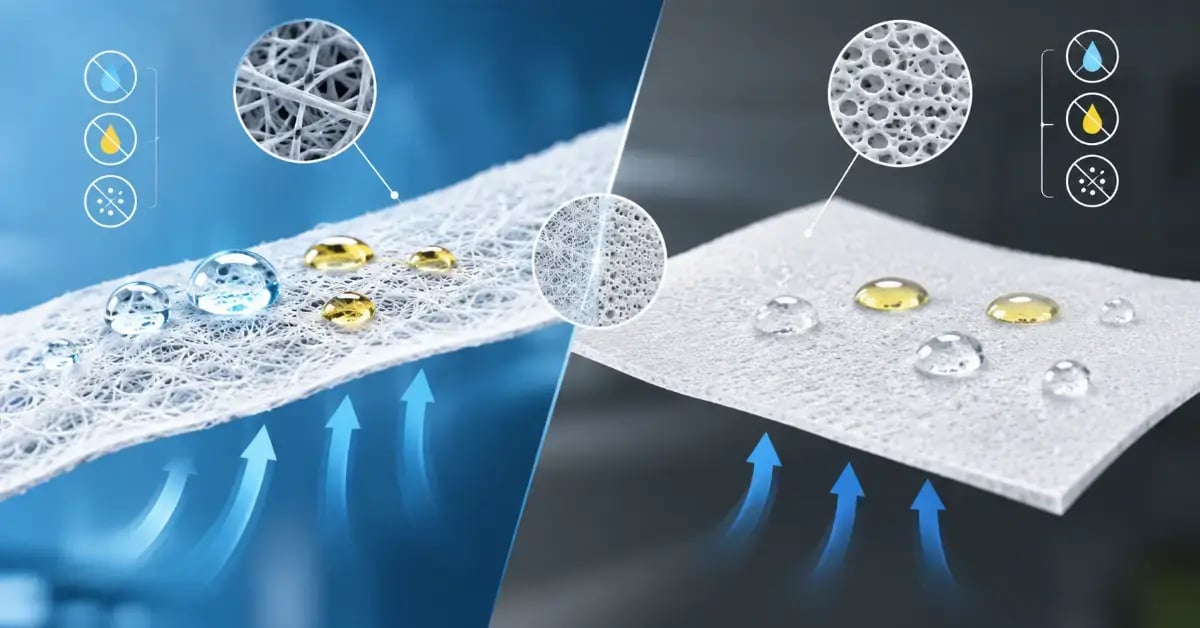
The table below summarizes general material tendencies. It is illustrative, not product test data. Individual grades from any supplier can fall outside these patterns, so confirm every row with product-specific reports.
|
Criterion |
PFAS-free oleophobic nanofiber (general) |
ePTFE (general) |
What to verify |
|
Airflow |
Tunable through fiber diameter, porosity, and thickness |
Wide range of grades available |
Air permeability at a stated pressure and sample area |
|
Water entry pressure |
Depends on pore size and surface energy |
Typically strong due to low surface energy |
WEP method, hold time, and pass/fail criteria |
|
Oil repellency |
Depends entirely on the non-fluorinated treatment |
Base PTFE is not reliably oleophobic; treated grades vary |
Grade and method, plus exposure to your actual fluids |
|
Particle protection |
Fine fibers support fine-particle capture |
Small pore structure supports particle barrier |
Efficiency at defined particle size and flow |
|
Pressure equalization |
Function of airflow and vent area |
Function of airflow and vent area |
Equalization time in your enclosure volume |
|
Chemical compatibility |
Depends on base polymer |
Broadly resistant |
Immersion or exposure to your chemicals |
|
Mechanical durability |
Usually relies on support layer |
Often laminated to a support |
Tensile, burst, and post-aging properties |
|
Temperature range |
Depends on base polymer |
Generally wide |
Continuous and peak ratings, with test basis |
|
PFAS status |
Must be documented, not assumed |
PTFE is a fluoropolymer; treatments may add PFAS |
Supplier declarations and, where needed, screening data |
Airflow and Air Permeability
Airflow determines how fast an enclosure can equalize pressure. Higher airflow usually means a more open structure, which can trade off against water entry pressure. Always compare values measured at the same differential pressure and test area.
Water Entry Pressure and Waterproof Performance
Water entry pressure (WEP) is the pressure at which liquid water first passes through the membrane. It depends on pore size and surface wettability. Check whether the value applies to the bare membrane or the finished vent assembly.
Oil Repellency and Oleophobicity
This is where PFAS-free materials face the hardest test. Ask for a graded oil repellency result and, more importantly, test against the fluids your product will actually see, such as engine oil, coolant, cleaners, or skin oils.
Particle Filtration and Contaminant Protection
Both material types can provide fine-particle protection. Request efficiency data at defined particle sizes rather than relying on nominal pore size alone.
Pressure Equalization and Venting Efficiency
Venting performance depends on membrane airflow, vent opening area, and enclosure volume. A lower-airflow membrane may still work if the vent area is larger.
Chemical Compatibility and Environmental Exposure
PTFE resists most chemicals. Nanofiber performance depends on the polymer chosen. Test both materials against your specific exposure list.
Mechanical Strength, Durability, and Service Life
Thin membranes are typically laminated to nonwoven or woven supports. Evaluate tensile strength, burst resistance, abrasion, and how properties change after aging.
Temperature Resistance and Operating Conditions
PTFE tolerates a wide temperature range. Nanofiber ratings depend on the polymer, treatment, and adhesive system. Confirm the continuous and peak limits for the complete vent.
PFAS Composition, Documentation, and Compliance Considerations
US PFAS requirements are evolving at both federal and state levels. Federally, EPA's TSCA Section 8(a)(7) rule requires one-time reporting on PFAS manufactured or imported between 2011 and 2022, including PFAS-containing articles; EPA moved the start of the submission period to January 31, 2027, or 60 days after a forthcoming final rule, whichever comes first.
At the state level, Maine and Minnesota will prohibit most products containing intentionally added PFAS from January 1, 2032, unless the use is designated a currently unavoidable use. Definitions differ: New Mexico's law exempts fluoropolymers, unlike Maine's and Minnesota's. That means the same ePTFE vent can be treated differently depending on where your product is sold. This is general information, not legal advice; confirm obligations with your compliance team or counsel.
Essential Specifications to Compare Before Choosing a Venting Membrane
A data sheet is only useful if you know why each number matters. Compare these parameters, and always note the test method and conditions behind them.
|
Specification |
Why it matters |
|
Airflow or air permeability |
Sets how quickly pressure equalizes and how much vent area you need |
|
Water entry pressure |
Indicates resistance to rain, spray, washdown, and immersion |
|
Oil repellency rating and method |
Predicts resistance to oils, fuels, and surfactants that wet out membranes |
|
Pore size or distribution |
Influences particle barrier and the airflow/WEP balance |
|
Thickness and basis weight |
Affect stiffness, handling, die-cutting, and airflow |
|
Operating temperature range |
Determines suitability near engines, power electronics, or outdoors |
|
Chemical resistance |
Confirms stability against cleaners, fluids, and process chemicals |
|
Tensile strength and integrity |
Governs survival during assembly, pressure cycling, and impact |
|
Adhesion and mounting compatibility |
Determines whether the vent seals reliably by adhesive, welding, or overmolding |
|
Dust and particle protection |
Supports enclosure protection goals and sensor cleanliness |
|
Environmental aging and durability |
Shows whether performance holds after heat, humidity, UV, and cycling |
|
PFAS-related material declarations |
Supports customer requirements, reporting, and market access |
No single number decides the selection. A membrane with excellent airflow but marginal oil repellency may fail in a powertrain sensor yet perform well in a sealed indoor electronics housing.
Venting Membrane Test Data: Which Tests Should Engineers Request?
Ask every supplier for the test method, sample conditioning, number of specimens, and the mean and range of results. A single "typical" value tells you little about consistency. The methods named below are commonly used in the membrane and textile industries; confirm with each supplier which method was actually used.
Air Permeability Testing
Measures airflow through a known area at a set pressure differential. ASTM D737 (air permeability of textile fabrics) is widely referenced; some suppliers report Gurley-type values instead. Only compare results taken with the same method and units.
Water Penetration and Water Entry Pressure Testing
Hydrostatic methods such as ISO 811 or AATCC 127 raise water pressure on one side until penetration occurs. For finished products, IEC 60529 IP ratings apply to the complete enclosure, not the membrane alone.
Oil Repellency Testing
AATCC 118 and ISO 14419 grade repellency by placing a series of hydrocarbon test liquids on the surface. Higher grades resist lower-surface-tension liquids. Supplement this with soak or drop tests using your real fluids.
Particle Protection and Filtration Testing
Request efficiency at defined particle sizes and face velocity. Pore-size methods such as bubble point (ASTM F316) describe structure but do not replace direct efficiency data.
Temperature, Chemical, and Aging Tests
Ask for property retention after heat aging, humidity, thermal cycling, UV, and chemical exposure. Retention of airflow, WEP, and oil grade after aging is more meaningful than initial values.
Mechanical Strength and Durability Testing
Request tensile strength in both directions, burst or pressure-cycle resistance, and adhesion or peel data for the mounted vent.
PFAS Screening and Material Documentation
Request a written PFAS declaration stating the definition used. Where needed, ask for screening data such as total organic fluorine analysis, which can indicate fluorine content but does not identify specific substances.
Example test-data request template (illustrative only, not actual results):
|
Property |
Test method |
Conditions |
Result requested |
Supplier value |
|
Air permeability |
e.g., ASTM D737 |
Pressure, test area |
Mean, range, units |
To be supplied |
|
Water entry pressure |
e.g., ISO 811 |
Ramp rate, hold time |
Mean, minimum |
To be supplied |
|
Oil repellency |
e.g., AATCC 118 / ISO 14419 |
Conditioning |
Grade |
To be supplied |
|
Particle efficiency |
Supplier method |
Particle size, velocity |
Efficiency % |
To be supplied |
|
Post-aging retention |
Supplier method |
Aging protocol |
% of initial values |
To be supplied |
|
Tensile strength |
Supplier method |
MD/CD |
Mean, units |
To be supplied |
|
PFAS status |
Declaration / screening |
Definition used |
Statement, report |
To be supplied |
Which Membrane Is Better for Your Application?
The right choice depends on your operating conditions, required protection level, and validated test results, not on material category alone.
Electronics Enclosures and Pressure Equalization
Indoor and handheld electronics usually prioritize airflow, water resistance, and dust protection, with limited oil exposure. These moderate conditions often make them a practical starting point for PFAS-free nanofiber evaluations.
Automotive Components and Sensor Protection
Headlamps, ECUs, and sensors face heat, washdown, road salt, and automotive fluids. Validate oil repellency against the actual fluids, plus thermal cycling and long-term aging, before switching from an established ePTFE vent.
Industrial Equipment and Outdoor Enclosures
Outdoor telecom, lighting, and controls need UV, humidity, and temperature durability. Request aging data that reflects your outdoor exposure profile.
Applications Requiring Oil Resistance
Gearboxes, motors, and food-processing or kitchen equipment demand strong oleophobicity. Here, compare graded oil results side by side and run immersion tests with your fluids.
Products with PFAS-Related Material Restrictions
If customers or target markets restrict intentionally added PFAS, a documented PFAS-free membrane can simplify compliance. It still has to meet every performance requirement in your specification.
How to Evaluate a PFAS-Free ePTFE Alternative
Use this checklist to structure a qualification program:
- Performance requirements: Define minimum airflow, WEP, oil grade, and particle protection before testing.
- Material composition: Confirm base polymer, treatment chemistry, support layer, and adhesive.
- Test reports: Obtain methods, conditions, sample counts, and statistical ranges.
- Manufacturing consistency: Ask about lot-to-lot variation, in-process controls, and quality certifications held.
- Integration: Verify die-cutting, adhesive mounting, heat welding, or overmolding compatibility.
- Durability: Run aging and cycling tests that match your product life and warranty.
- Documentation: Collect PFAS declarations and other material compliance statements your customers require.
- Total cost of ownership: Weigh unit cost against qualification effort, yield, field failures, and compliance workload.
How to Request a Venting Membrane Sample for Testing
A detailed request helps Matregenix recommend the right membrane construction and speeds up your evaluation.
Information to Provide When Requesting a Sample
- Intended application and end-use environment
- Required airflow and pressure equalization targets
- Water and oil exposure conditions, including specific fluids
- Temperature range and chemical exposure
- Membrane dimensions and mounting method
- Target performance specifications
- PFAS-related documentation requirements and the definition you must meet
- Preferred sample size, quantity, and testing plan
What to Evaluate During Sample Testing
Test candidate membranes and your current ePTFE baseline side by side, using the same methods, equipment, conditioning, and operator. Test several specimens per material, record means and ranges, and repeat key tests after aging. Finish with tests in the actual enclosure, because assembly can change real-world venting and sealing performance.
Questions to Ask Your Membrane Supplier
- Can you provide a technical data sheet with test methods and conditions?
- Which PFAS definition does your declaration follow, and what supports it?
- Can fiber structure, airflow, or lamination be customized?
- What sample formats and quantities are available?
- What are typical sample and production lead times?
- What technical support is available during qualification?
Conclusion: Choose a Venting Membrane Based on Verified Performance
PFAS-free oleophobic nanofiber membranes and ePTFE can both deliver breathable, protective venting. The deciding factors are airflow, water entry pressure, oil repellency, particle protection, temperature and chemical resistance, durability, and documented material composition.
General material trends are a starting point, not a decision. Define your requirements, request data with clear test methods, verify PFAS declarations against the definitions that apply to your markets, and test samples side by side in your own enclosure before committing to production.
Ready to Evaluate a PFAS-Free Alternative?
Request a Matregenix PFAS-free nanofiber venting membrane sample or technical data sheet today. Share your application, airflow and water entry targets, oil exposure, and documentation needs, and our engineering team will help you select a membrane for side-by-side testing against your current ePTFE vent.
Frequently Asked Questions
What is a PFAS-free oleophobic venting membrane?
It is a breathable membrane that repels water and oils and is made without intentionally added PFAS. All three properties should be confirmed by supplier documentation and testing.
Are PFAS-free nanofiber membranes a viable alternative to ePTFE?
For many applications they can be, but viability depends on your specific airflow, waterproofing, oil resistance, temperature, and durability requirements. Validate with side-by-side testing.
What is the difference between hydrophobic and oleophobic membranes?
Hydrophobic membranes resist water. Oleophobic membranes also resist low-surface-tension liquids such as oils, fuels, and surfactants.
How do you compare airflow and water entry pressure?
Compare values measured with the same method, pressure, and test area. Higher airflow often comes with lower WEP, so evaluate the balance against your requirements.
Which tests are important when evaluating venting membranes?
Air permeability, water entry pressure, oil repellency, particle efficiency, mechanical strength, aging, chemical exposure, and PFAS documentation.
Can a membrane be oleophobic without PFAS?
Yes, non-fluorinated approaches exist, but repellency levels vary. Confirm the grade and test with the fluids your product will encounter.
How can buyers verify a membrane's PFAS-free status?
Request a written declaration that names the PFAS definition used, plus supporting supply-chain information and, where appropriate, analytical screening such as total organic fluorine.
What information is needed to request a membrane sample?
Application, environment, airflow and WEP targets, fluid exposure, temperature range, dimensions, mounting method, and documentation needs.
Which industries use protective venting membranes?
Automotive, consumer and industrial electronics, telecom, lighting, energy storage, medical devices, and packaging.
How can engineers validate membrane performance before production?
Run lab tests on multiple lots, then aging and environmental tests, then in-product validation in the final enclosure under realistic conditions.