
What a nanofiber CDMO project looks like: feasibility, pilot, scale-up, quality documentation ( ISO clean room, QMS, ASTM F3510
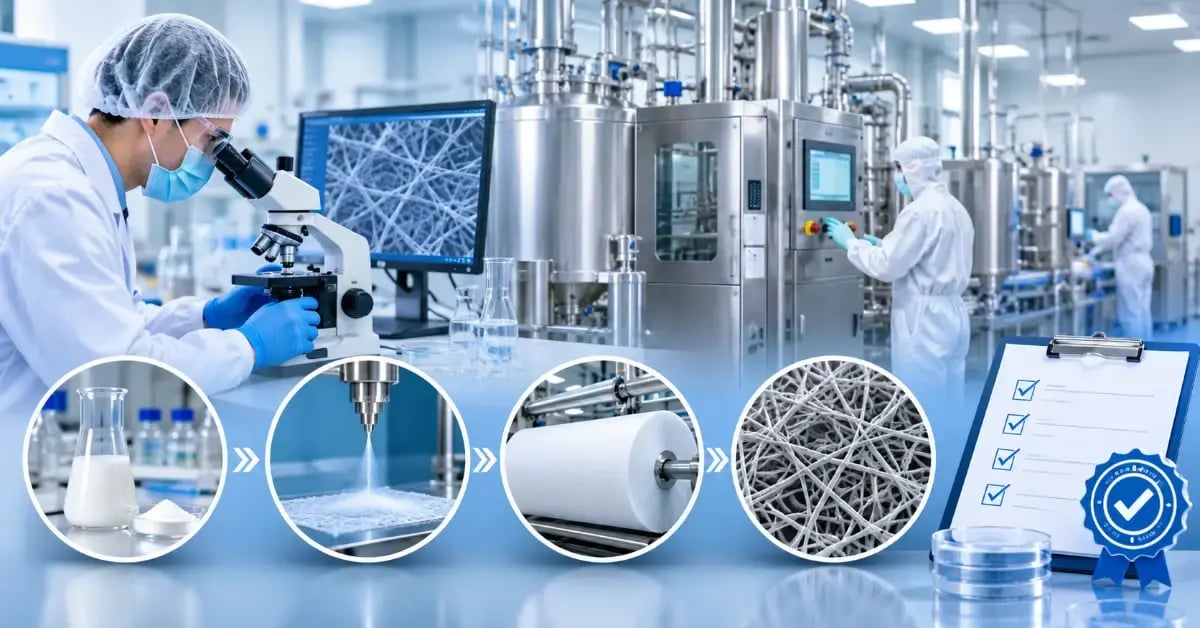
Introduction: Why a Clear Nanofiber CDMO Roadmap Matters
You have a promising idea. Maybe it is a wound dressing, a drug-eluting scaffold, or a high-performance filter. However, turning that idea into a product people can buy is a different challenge. That is where a nanofiber CDMO comes in.
A contract development and manufacturing organization (CDMO) helps you move from concept to commercial supply. Yet many teams in the USA start a project without knowing what each stage involves. As a result, budgets slip, timelines stretch, and regulatory files come together too late.
This guide walks you through a typical nanofiber CDMO project, step by step. You will learn what happens during feasibility, pilot production, and scale-up. In addition, you will see how quality documentation, ISO clean rooms, a QMS, and ASTM F3510 fit into the picture. By the end, you will know what to expect and what to ask your partner.
What Is a Nanofiber CDMO?
A nanofiber CDMO is a partner that both develops and manufactures nanofiber materials for other companies. In other words, you bring the product goal, and the CDMO brings the equipment, process know-how, and quality systems.
Most nanofibers are made by electrospinning. In this process, a high voltage pulls a polymer solution into extremely thin fibers, often a few hundred nanometers wide. These fibers form a porous mat that looks and behaves much like the body's own extracellular matrix. For this reason, nanofiber technology is popular in medical devices, drug delivery, tissue engineering, and filtration.
Nanofiber CDMO vs. Standard Nanofiber Contract Manufacturing
Nanofiber contract manufacturing usually means a supplier makes a product to your existing specification. A CDMO goes further. It helps you design the material, develop the nanofiber manufacturing process, prove it works, and then produce it at scale. Therefore, a CDMO is often the better fit when your product is still evolving.
Who Uses Electrospinning Contract Manufacturing?
Typical clients include:
- Medical device startups building implants, wound care, or surgical meshes
- Pharmaceutical companies exploring drug-loaded fibers
- Research teams moving a lab discovery toward commercialization
- Industrial firms that need advanced filtration or barrier media
Each of these groups needs reliable nanofiber solutions, but they rarely want to build an electrospinning facility from scratch.
Phase 1: Feasibility – Can Your Nanofiber Concept Work?
Every strong nanofiber CDMO project starts with a feasibility study. The goal is simple: find out whether your idea can be made, and made well, before you spend heavily.
Defining the Target Product Profile
First, you and the CDMO agree on what success looks like. This is often called a target product profile. It covers the intended use, key performance needs, and any regulatory path. For example, a wound dressing may need a set pore size, a certain tensile strength, and a defined degradation time.
Material and Polymer Selection
Next, the team selects candidate polymers and solvents. Common choices include PCL, PLGA, PLA, nylon, and PVDF. Natural materials like collagen, gelatin, or silk can also be used. Each option affects strength, flexibility, biocompatibility, and how fast the material breaks down.
Early Electrospinning Trials
Then the lab runs small trials. Engineers adjust voltage, flow rate, solution concentration, needle distance, humidity, and temperature. Small changes here can make a big difference in fiber diameter and uniformity.
Characterization and Go/No-Go Decision
After each trial, samples are tested. Scanning electron microscopy (SEM) shows fiber size and structure. Other tests may measure porosity, thickness, mechanical strength, and wettability.
At the end of feasibility, you receive a short report with data and a clear recommendation. Feasibility usually takes about 4 to 12 weeks, depending on complexity. If the results look good, you move to the pilot phase with confidence.
Phase 2: Pilot Production – Proving the Process Is Repeatable
Feasibility shows that something can be made. The pilot phase shows that it can be made the same way, again and again.
Locking the Process Parameters
During the pilot stage, the CDMO narrows the process window. Engineers define the exact ranges for voltage, flow rate, collector speed, and environmental conditions. They also write draft work instructions so that any trained operator can follow the same steps.
Building Pilot Batches
Next, the team produces several small batches. These batches are larger than lab samples but smaller than full production. They give you enough material for bench testing, animal studies, or early customer trials.
Testing Batch-to-Batch Consistency
Consistency is the main focus here. The CDMO compares fiber diameter, thickness, basis weight, and mechanical results across batches. If one batch drifts, the team finds the root cause and adjusts. As a result, you get data that proves the nanofiber manufacturing process is under control.
Setting Draft Specifications
By the end of the pilot phase, you should have draft specifications for raw materials, in-process checks, and finished product. These specs become the backbone of your later quality documentation. Pilot work often runs 2 to 6 months.
Phase 3: Nanofiber Scale-Up – From Pilot Batches to Commercial Volume
Nanofiber scale-up is often the hardest step. A process that works on a small benchtop unit may behave very differently on larger equipment.
Why Scale-Up Is Challenging
In electrospinning, output depends on many linked factors. For instance, adding more nozzles or moving to needleless systems can change the electric field. Larger collectors can affect fiber alignment and thickness. Moreover, solvent evaporation and humidity become harder to manage in bigger spaces.
Technology Transfer and Equipment Choices
A good nanofiber CDMO plans for scale-up early, not at the last minute. The team picks equipment that can grow with your demand, such as multi-nozzle heads or roll-to-roll systems. Then it transfers the pilot process to that equipment and checks that key outputs stay the same.
Process Validation: IQ, OQ, and PQ
For medical products, scale-up includes formal validation. This usually follows three steps:
- Installation Qualification (IQ): confirms the equipment is installed correctly.
- Operational Qualification (OQ): proves the equipment runs within set limits.
- Performance Qualification (PQ): shows the process makes conforming product over several runs.
Together, these steps give regulators and customers proof that your product is made reliably.
Supply Chain and Capacity Planning
Finally, scale-up covers the business side. The CDMO qualifies raw material suppliers, sets lead times, and plans capacity. Therefore, when demand grows, you are not caught short.
Phase 4: Quality Documentation in a Nanofiber CDMO Project
Quality documentation is not a final step you add at the end. Instead, it runs alongside every phase. However, it becomes most visible as you prepare for clinical use or commercial launch. Three pillars matter most: ISO clean rooms, a quality management system (QMS), and recognized test standards such as ASTM F3510.
ISO Clean Room Manufacturing
Nanofibers have a huge surface area, so they can easily trap dust and microbes. For medical and pharmaceutical products, this risk must be controlled. That is why many products are made in ISO-classified clean rooms.
Clean rooms are graded under ISO 14644-1 by the number of airborne particles allowed. ISO Class 7 and ISO Class 8 are common for medical device work. A strong CDMO will monitor particles, pressure, temperature, and humidity on a regular schedule. It will also train staff in gowning and clean room behavior. In turn, these records become part of your product file.
Quality Management System (QMS)
A QMS is the set of procedures that controls how a product is designed, made, tested, and released. For medical devices, the core standard is ISO 13485. In the USA, the FDA's Quality Management System Regulation (QMSR) now aligns 21 CFR Part 820 closely with ISO 13485.
In practice, a solid QMS at your nanofiber CDMO covers:
- Document control and change control
- Design controls and risk management (ISO 14971)
- Supplier qualification and incoming inspection
- Batch records and device history records
- Nonconformance, CAPA, and complaint handling
- Training records and internal audits
As a result, you get a clear trail showing how each lot was made. This trail is exactly what auditors and FDA reviewers look for.
ASTM F3510 for Fiber-Based Medical Products
ASTM F3510 is a standard guide for characterizing fiber-based constructs used in tissue-engineered medical products. Put simply, it helps teams describe and measure electrospun scaffolds in a consistent way.
The guide points to key properties such as fiber diameter, pore size, porosity, fiber alignment, and mechanical behavior. It also lists suitable test methods, like SEM imaging. Using ASTM F3510 brings several benefits:
- Your data follows a recognized, common language
- Results are easier to compare across batches and labs
- Regulatory submissions look more complete and credible
Therefore, ask your CDMO early whether it builds its characterization plan around ASTM F3510.
Typical Quality Deliverables
By the end of the project, you should expect a document package that may include:
- Material and process specifications
- Validation protocols and reports (IQ, OQ, PQ)
- Certificates of analysis for each lot
- Clean room monitoring data
- Risk management file
- Characterization reports aligned with ASTM F3510
This package supports your 510(k), De Novo, or PMA submission, and it builds trust with your customers.
Typical Nanofiber CDMO Project Timeline
Every project is different, but most follow a similar rhythm. The table below gives a rough guide.
|
Phase |
Typical duration |
Main output |
|
Feasibility |
4–12 weeks |
Proof of concept and go/no-go report |
|
Pilot production |
2–6 months |
Repeatable process and draft specs |
|
Scale-up and validation |
4–12 months |
Validated process at commercial volume |
|
Quality documentation |
Ongoing |
Complete, audit-ready file |
Keep in mind that regulatory testing, such as biocompatibility studies, may add time. Planning these early helps you avoid delays.
How to Choose the Right Nanofiber CDMO Partner
Not every partner offers the same depth. When you compare nanofiber CDMO options, ask these questions:
- Experience: Have they worked with your polymer and your product type?
- Range of equipment: Can they support you from lab scale to commercial volume?
- Clean room access: Do they offer ISO-classified clean room manufacturing?
- Quality system: Is their QMS built around ISO 13485 and FDA expectations?
- Standards: Do they use ASTM F3510 and other recognized test methods?
- Communication: Will you get clear reports and a dedicated project contact?
- IP protection: How do they protect your formulas and process data?
A partner who answers these questions clearly will save you time, money, and stress.
Conclusion: Turning Nanofiber Technology Into Real Products
A nanofiber CDMO project is a journey with four clear stages. Feasibility proves your idea can work. Pilot production proves it can be repeated. Scale-up proves it can meet market demand. Meanwhile, quality documentation proves it is safe, consistent, and ready for regulators.
When you understand each stage, you can plan better and ask sharper questions. Most importantly, you can choose a partner who supports you from the first fiber to the final shipment.
Ready to Start Your Nanofiber CDMO Project?
Whether you have a rough concept or a lab-proven prototype, Matregenix can help you take the next step. Our team offers end-to-end nanofiber solutions, from feasibility studies and pilot batches to scale-up and audit-ready quality documentation.
Let's turn your nanofiber technology into a product the market can trust. Contact Matregenix today to schedule a free project consultation and find out how our electrospinning contract manufacturing expertise can speed up your path to launch.
Frequently Asked Questions About Nanofiber CDMO Projects
1. What does a nanofiber CDMO do?
A nanofiber CDMO develops and manufactures nanofiber materials for other companies. It supports material selection, process development, scale-up, quality documentation, and commercial supply, so you do not need to build your own facility.
2. How is a nanofiber CDMO different from nanofiber contract manufacturing?
Nanofiber contract manufacturing usually means producing a product to an existing specification. A CDMO also helps you design and develop that product and its manufacturing process from the start.
3. How long does a nanofiber CDMO project take?
Most projects take between 6 months and 2 years. Feasibility often needs 4 to 12 weeks, pilot work 2 to 6 months, and scale-up with validation 4 to 12 months.
4. What is the biggest challenge in nanofiber scale-up?
The biggest challenge is keeping fiber quality the same on larger equipment. Changes in the electric field, airflow, humidity, and solvent evaporation can alter fiber size and uniformity, so careful process transfer and validation are essential.
5. Why are ISO clean rooms important in nanofiber manufacturing?
Nanofibers have a very high surface area and can trap particles or microbes easily. ISO-classified clean rooms control contamination, which is critical for medical devices, implants, and drug delivery products.
6. What is ASTM F3510 and why does it matter?
ASTM F3510 is a standard guide for characterizing fiber-based constructs in tissue-engineered medical products. It helps teams measure properties like fiber diameter, porosity, and pore size in a consistent and recognized way.
7. Which industries use electrospinning contract manufacturing?
Medical devices, pharmaceuticals, tissue engineering, wound care, filtration, energy storage, and textiles all use electrospinning contract manufacturing. Each benefits from the high surface area and fine structure of nanofibers.