
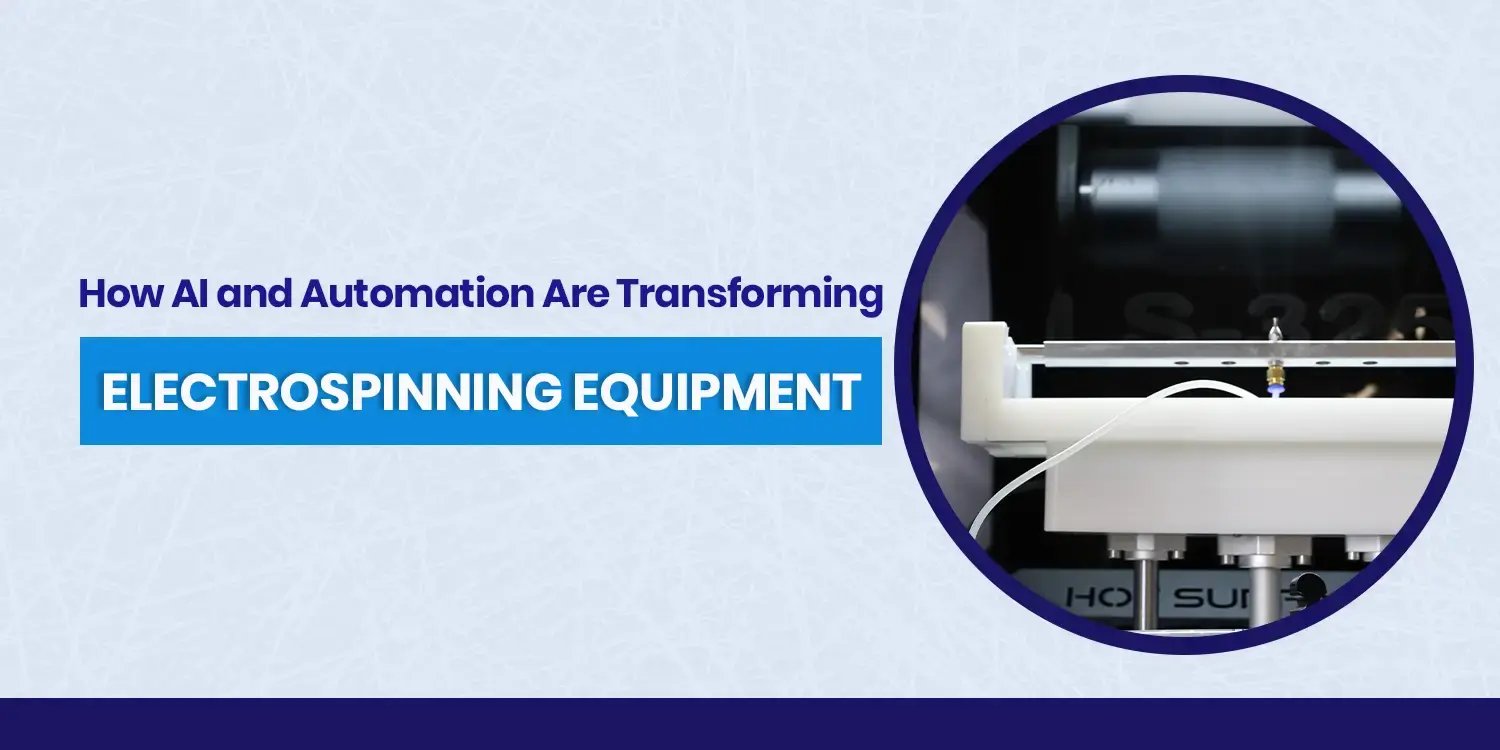
Electrospinning has long been admired for its ability to produce ultra-fine nanofibers with remarkable precision. But let’s be honest traditional electrospinning setups often demand constant human supervision, trial-and-error adjustments, and plenty of patience. That’s where AI and Automation in Electrospinning Equipment step in, quietly reshaping how nanofibers are manufactured.
Today, electrospinning is no longer just about high voltage and polymer solutions. It’s about smart systems, adaptive machines, and data-driven decisions that are making nanofiber production faster, cleaner, and far more consistent. Let’s explore how this technological shift is unfolding and why it matters for the future of advanced materials.
The Evolution of Electrospinning Technology
Electrospinning began as a largely manual process. Operators adjusted parameters like voltage, flow rate, and collector distance based on experience and observation. While effective, this approach left room for inconsistency, especially in large-scale production.
With the rise of AI in electrospinning machines, the process has evolved into something far more intelligent. Sensors, machine learning algorithms, and automated controls now work together to fine-tune fiber production in real time. This evolution marks a decisive leap toward smarter, more scalable nanofiber manufacturing.
The Role of AI in Electrospinning Equipment
Real-Time Process Optimization
One of the most impactful benefits of AI and Automation in Electrospinning Equipment is real-time optimization. AI systems continuously analyze parameters such as humidity, temperature, jet stability, and fiber diameter. When deviations occur, the system responds instantly no human intervention needed.
This level of responsiveness ensures uniform fiber morphology and significantly reduces material waste. In short, AI transforms electrospinning from a reactive process into a proactive one.
Predictive Intelligence and Error Reduction
Another game-changing advantage of AI in nanofiber production is predictive maintenance. AI models can detect subtle patterns that indicate equipment wear or instability long before a failure occurs.
Instead of unexpected downtime, manufacturers receive early alerts, allowing for planned maintenance. This predictive intelligence enhances machine longevity and keeps production lines running smoothly an often-overlooked but critical benefit.
Automation: Redefining Nanofiber Manufacturing
From Manual Control to Fully Automated Systems
Automation eliminates many of the repetitive and error-prone tasks associated with traditional electrospinning. Automated syringe pumps, robotic collectors, and programmable controllers ensure each production cycle follows precise specifications.
This shift toward automated nanofiber manufacturing improves repeatability, which is essential for industries like medical textiles, filtration, and energy storage where consistency is non-negotiable.
Scaling Up Without Compromising Quality
Scaling electrospinning has always been challenging. Automation changes the equation. With AI-guided automation, multiple spinning units can operate simultaneously while maintaining identical fiber characteristics.
This makes industrial-scale production not only feasible but reliable unlocking new commercial opportunities for nanofiber-based products.
Smart Data: The Hidden Power Behind AI-Driven Electrospinning
Data is the quiet engine powering AI and Automation in Electrospinning Equipment. Every run generates valuable insights solution behavior, environmental conditions, output quality, and more.
AI systems learn from this data, refining future processes and building a knowledge base that grows smarter over time. This self-learning capability leads to continuous improvement, even without direct human input.
Future of Electrospinning Technology with AI
Self-Learning Machines and Adaptive Systems
The future of electrospinning technology with AI is remarkably promising. Next-generation systems are expected to self-calibrate entirely, adapting to new polymers or formulations with minimal setup.
Imagine an electrospinning machine that “learns” how a new material behaves and adjusts itself accordingly. That future is closer than it seems.
Integration with Industry 4.0
AI-powered electrospinning equipment is increasingly compatible with Industry 4.0 frameworks. Cloud connectivity, digital twins, and remote monitoring allow manufacturers to oversee production from anywhere in the world.
This connectivity enhances transparency, traceability, and decision-making key pillars of modern manufacturing ecosystems.
Sustainability and Efficiency Gains
AI-driven automation isn’t just about productivity; it’s also about sustainability. Optimized processes reduce solvent waste, energy consumption, and rejected batches.
By making electrospinning more efficient, AI in electrospinning machines supports greener manufacturing practices an increasingly important consideration in today’s environmentally conscious market.
Why AI and Automation Matter for Competitive Advantage
Companies adopting AI and Automation in Electrospinning Equipment gain a significant edge. Faster development cycles, consistent quality, and lower operational costs translate directly into stronger market positioning.
As customer demands grow more complex, smart electrospinning systems provide the agility needed to innovate without sacrificing reliability.
Challenges and Considerations
While the benefits are substantial, implementation does come with challenges. Initial investment costs, data integration, and the need for skilled personnel can be hurdles.
However, as AI tools become more accessible and user-friendly, these barriers are steadily diminishing making advanced electrospinning technology more attainable than ever.
Conclusion
The fusion of AI and automation is redefining what electrospinning equipment can achieve. From intelligent process control to scalable manufacturing, AI and Automation in Electrospinning Equipment are no longer optional upgrades they are essential drivers of progress.
As the technology matures, the line between machine and decision-maker continues to blur, opening new frontiers in nanofiber innovation.
Partner with Matregenix
At Matregenix, we believe innovation should feel practical, not overwhelming. Our expertise in advanced material solutions and forward-thinking technologies positions us at the forefront of intelligent nanofiber manufacturing. By embracing AI and Automation in Electrospinning Equipment, we help our partners move beyond limitations and into scalable, future-ready production.
Whether you’re exploring automated nanofiber manufacturing or preparing for the future of electrospinning technology with AI, Matregenix is here to guide you every step of the way. Connect with our team today and discover how smart electrospinning solutions can elevate your products, streamline your processes, and keep you ahead in a rapidly evolving materials landscape.